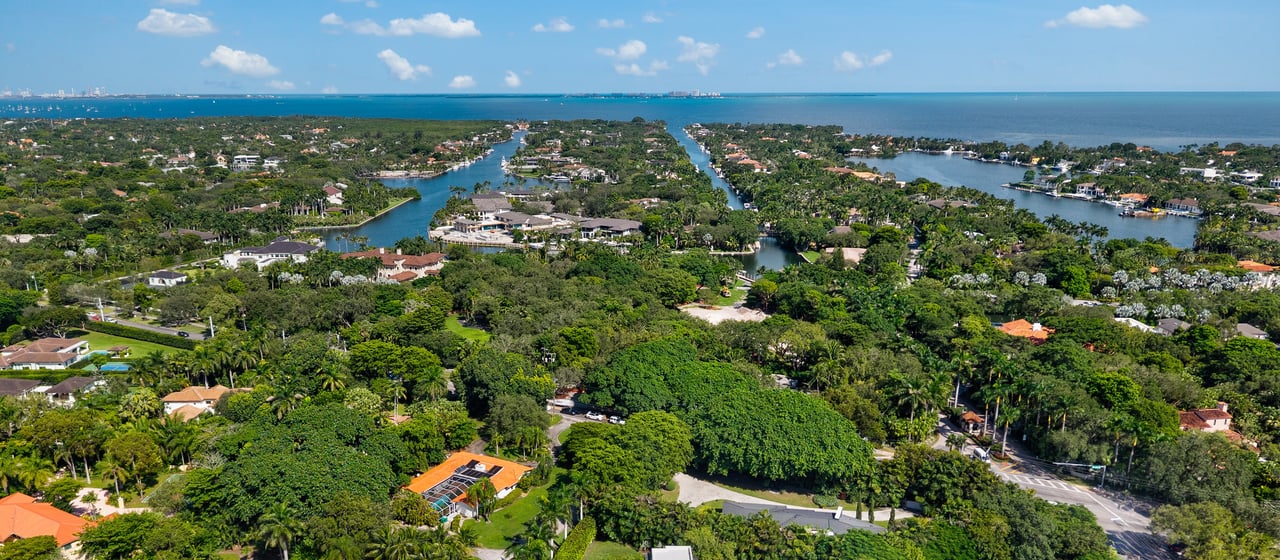
Camp Biscayne is Coconut Grove's most romantic gated enclave — roughly 21 to 26 homes set under a mature canopy of giant oaks on park-like grounds near Dinner Key, on land that began as a 1920s winter resort. Homes here generally trade from the low millions into the mid-teens, and what you're really buying is something money usually can't manufacture: old trees, history, and a hushed, natural setting steps from Biscayne Bay and the Coconut Grove Sailing Club. If you want the Grove's character distilled into one address, this is it.
I've always thought of Camp Biscayne as the enclave that feels the least like Miami in the best possible way. There's no glass-and-stucco sameness here. You drive in under a ceiling of oak limbs, and it feels like a private botanical garden that happens to have homes in it.
A genuine piece of Coconut Grove history
Camp Biscayne started life as a winter resort in the 1920s — by local lore, a retreat that hosted names like the Rockefeller family and Alexander Graham Bell. That history is still legible in the grounds: the giant oaks, the natural landscaping, the sense that the homes were placed into a landscape rather than carved out of a graded lot. Today it holds roughly two dozen residences, and the tree canopy remains the defining feature. (Home count and historical details reflect spring 2026 sources and local history; verify specifics during diligence.)
Insider note: Mature tree canopy is one of the few luxury features in Miami you literally cannot buy new. A developer can pour marble and install an elevator in eighteen months; they cannot conjure a hundred-year-old oak. In Camp Biscayne, that canopy is doing real work on value, and it's the first thing I point out to buyers who've only seen new construction.
The homes and the setting
Architecture in Camp Biscayne leans historic and characterful — original and lovingly updated homes rather than a uniform spec-build look — on lots defined by their landscaping and proximity to the bay. The enclave is gated and quiet, and its location near Dinner Key puts it within steps of the water and the Coconut Grove Sailing Club, with the Grove's village center a short walk or drive away.
It's a different animal from the Grove's boater-first enclaves. Where Hughes Cove is organized around a private boat basin and deep-water access, Camp Biscayne is organized around place — the trees, the history, the walkability. For the full comparison across enclaves, see my guide to the best gated communities in Coconut Grove.
Lifestyle and what's nearby
The appeal of Camp Biscayne is how much sits within a few minutes. Dinner Key and the Coconut Grove Sailing Club — home to one of Miami's strongest youth sailing and summer-camp programs — are right there, a real draw for families who want their kids on the water. Coral Reef Yacht Club is close as well. The Grove's restaurants, farmers' markets, and walkable village streets are an easy stroll, and the neighborhood's private schools (Ransom Everglades, Carrollton, St. Stephen's) are all nearby. I cover the sailing programs in my Coconut Grove Sailing Club youth guide and the schools in my private schools guide.
Owning a historic Grove home: the realities
Camp Biscayne's charm comes with responsibilities that newer construction doesn't carry, and the buyers who are happiest here go in understanding them. None of these are reasons not to buy — they're simply the price of admission to something genuinely special.
The tree canopy is protected, and that's the point. Coconut Grove's mature oaks are subject to tree ordinances, and in an enclave defined by its canopy, you should expect real limits on clearing or significant landscaping changes. If your vision involves a modern, open lot, Camp Biscayne is probably not your enclave. If you want to live inside a hundred-year-old landscape, it's perfect — but understand the rules before you plan a renovation.
Renovating older homes thoughtfully. Many homes here are original or character-rich, which means renovations can uncover the realities of older construction — systems, roofs, and finishes that reflect their era. Budget for the unexpected, work with contractors who know historic Grove properties, and confirm any architectural review requirements early. Done well, a sensitive renovation of a Camp Biscayne home is one of the best value stories in the Grove.
Insurance and resilience. As a near-bay enclave, insurance, elevation, and storm resilience matter here as everywhere on the water. Older homes can carry differently than new builds, so price coverage during diligence and factor any resilience upgrades into your plan.
Resale and character premium. Historic character is exactly what makes Camp Biscayne homes hold their appeal — but it also means the buyer pool is specific. The people who want this enclave really want it, which supports value over time, but pricing is best set against the enclave's own comparable sales rather than generic Grove medians.
Insider note: I tell buyers that Camp Biscayne rewards a certain temperament. If you find the patina of an old home charming rather than a problem, and you'd rather preserve a canopy than clear it, you'll love it here in a way that's hard to put a number on. The people who struggle are the ones who wanted new construction and bought character by accident. Knowing which one you are is half the decision.
Frequently asked questions
How many homes are in Camp Biscayne?
Camp Biscayne contains roughly 21 to 26 homes, depending on the source, set on park-like grounds under a canopy of mature oaks.
What is the history of Camp Biscayne?
It began as a 1920s winter resort that, by local accounts, hosted notable guests including the Rockefeller family and Alexander Graham Bell. That heritage shows in the grounds and the home styles today.
How much do Camp Biscayne homes cost?
Homes generally trade from the low millions into the mid-teens, depending on the lot, the home, and proximity to the water. Verify current pricing against recent comparable sales.
Is Camp Biscayne near the water and sailing programs?
Yes — it sits near Dinner Key and the Coconut Grove Sailing Club, and is close to Coral Reef Yacht Club, making it convenient for boating and youth-sailing families.
Can you renovate a home in Camp Biscayne?
Yes, but thoughtfully. The enclave's mature oak canopy is subject to Coconut Grove's tree ordinances, and some renovations may involve architectural review, so confirm the rules before planning significant changes. Sensitive renovations of older homes here are often strong value plays.
Who is Camp Biscayne best suited for?
Buyers who value history, mature landscaping, and a quiet, park-like setting over new construction. The people who love it tend to love the patina and the canopy; those set on a modern, open lot are usually happier elsewhere in the Grove.
(FAQ schema recommended for this section.)
Find your place under the oaks
Camp Biscayne homes don't come up often, and when they do, the people who know the Grove move quickly. As a native Miamian who has spent a lifetime in these streets, I can tell you what's available, what's coming, and which homes are worth the premium. Reach out to me, Chanel Hunter Milian, and let's talk about getting you into one of the Grove's most special addresses.
