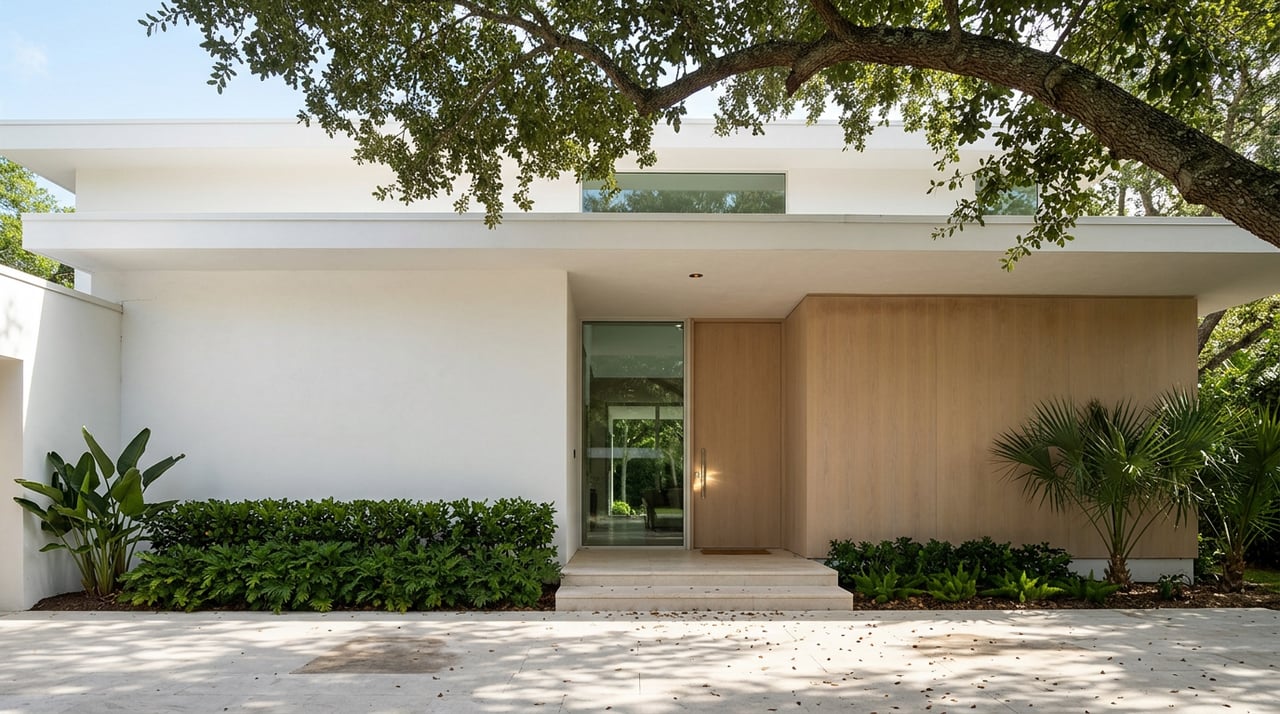
The headline on Ponce Davis in 2026 is scarcity. Four homes traded above $15 million in the last twelve months, ten cleared $10 million, and a new custom build on an acre is quietly asking $22 million. The fine print is stranger. In the same period, the neighborhood's median days on market ran 216, listings closed at roughly a 5% discount to ask, and one local data feed classified Ponce Davis as a buyer's market.
Both numbers are true. Neither is the story on its own.
The Thesis
Ponce Davis is the rare Miami luxury micro-market where the price floor and the days-on-market number are set by two different populations of buyers, and the sellers who bridge them are working without an HOA, without a city hall, and without a design covenant to protect resale. That structural fact is the reason a $22 million ask can coexist with a $5.525 million median, and it is the reason a well-prepared buyer has more leverage here this summer than in any adjacent Gables or Grove address.
"Ponce Davis sits between east and west Gables, in unincorporated Miami-Dade, and functions as Coral Gables at its most private expression."
That phrase carries most of what a relocating family needs to know, and most of what they miss. The "at its most private" part is the amenity. The "unincorporated" part is the mechanism.
The Jurisdictional Fine Print Buyers Discover at Closing
If a property's folio number starts with 30, it is unincorporated Miami-Dade. Ponce Davis is folio 30 territory. That means permitting, zoning review, and code enforcement run through the county's Department of Regulatory and Economic Resources, not through the City of Coral Gables Development Services desk you may have used on a prior Gables purchase.
For a buyer whose plan is turnkey, this is a footnote. For a buyer whose plan is to renovate, add a guest house, reconfigure a motor court, or tear down and rebuild, it is the whole conversation. A few specifics from the county's own guidance and the current permitting reality:
- Applications route through the EPS Portal, with Building, Fire, DERM, and DTPW reviewing in parallel depending on scope, per the Miami-Dade RER Building Division.
- Initial plan review runs 1 to 10 business days for straightforward work, with complex single-family projects typically taking four to eight weeks minimum once corrections cycle through.
- The entire county sits inside the High-Velocity Hurricane Zone, with design wind speeds of 170 to 200+ mph and a requirement that every exterior envelope product carry a Miami-Dade Notice of Acceptance.
- Starting work before issuance triggers double permit fees plus penalties, and paying the doubled fee does not stop enforcement.
The practical read: a Ponce Davis renovation is not a Coral Gables renovation with a different address. It is a different regulatory pathway with its own timeline, its own product-approval friction, and its own set of reviewing agencies. Underwrite the schedule accordingly, and pin down jurisdiction with your architect before design, not after.
What the Numbers Actually Say
The Q4 2025 Brown Harris Stevens Ponce-Davis report captured four single-family closings at a $6.04 million average and a $5.525 million median, against 13 active listings and a 9.8-month absorption period, with a 216-day median days on market and a 5% listing discount. Rocket's June 2025 read on the same territory put the median at $5,898,187 and price per square foot at $1,162, with a 51.4% year-over-year gain on median.
The county backdrop, per the Miami Association of Realtors and Freddie Mac data compiled through early April 2026: a Miami-Dade single-family median of $699,990 (up 3.7% year over year), 6.4 months of supply, closed sales up 2.8%, and $1M+ sales up 21.3%. Mortgage rates hovered between 6.2% and 6.5% through Q1 2026, settling at 6.46% by early April. Insurance is the sleeper variable. Citizens Property Insurance's spring 2026 rate action delivered an average 14.0% cut for Miami-Dade policyholders against an 8.7% statewide average, and at least 17 private insurers have re-entered the Florida market since the 2022–2023 reforms.
Layer those together and Ponce Davis looks like this:
| Signal | What it says | What it means for a buyer |
|---|---|---|
| $5.525M Q4 2025 median, $6.04M average | Trophy pricing is the norm | You are underwriting an estate asset, not a starter |
| 10 sales >$10M, 4 sales >$15M in the last year | A new price floor for renovated acre lots | Comparable evidence for lender and appraisal on top-of-market bids |
| 216 median days on market, ~5% listing discount | Slow absorption, real negotiation | Prepared buyers should be modeling 5–8% off ask on aged listings |
| 9.8-month absorption | Balanced-to-buyer territory | Sellers who priced in 2022 are recalibrating |
| Miami-Dade insurance premiums down ~14% in 2026 | Falling carrying cost | Recompute your total cost of ownership before your final number |
The paradox resolves once you separate the two buyer pools. Trades above $10 million tend to be new construction or fully reimagined acre-lot estates on the neighborhood's cleaner streets. The listings driving the 216-day median are older homes on smaller parcels priced against those trophy comps without the finishes or the land to support them. The floor is rising for the top of the neighborhood. The middle is where negotiation lives.
The Catalyst Next Door
The single most consequential local development for Ponce Davis values over the next five years is not inside Ponce Davis. It is a ten-minute drive north on Red Road.
Midtown Development, led by Alex Vadia, is redeveloping the ten-acre Shops at Sunset Place site as Downtown SoMi, with Heatherwick Studio as design architect and ODP as architect of record. The approved plan calls for seven towers ranging from 12 to 33 stories, 1,513 residences, a 287-room hotel, a 1,300-seat performing arts and movie theater, roughly 150,000 square feet of retail, and about 50,000 square feet of office, integrated around a new pedestrian street grid adjacent to the South Miami Metrorail station. The South Miami City Commission unanimously approved the site plan in October 2024. Demolition was set to begin in Q1 2026, and in mid-July 2026 Midtown petitioned Miami-Dade County to create the Downtown SoMi Community Development District, a special-purpose entity structured to finance roughly $149 million of infrastructure. Phase one, including streets and a condo-hotel, is targeted for 2029.
Two implications for Ponce Davis buyers. First, the neighborhood's practical center of gravity for daily walkable retail, restaurants, and entertainment shifts north, away from US-1's current retail strip and toward a Heatherwick-designed pedestrian core five minutes from every Ponce Davis driveway. Second, the CDD structure adds a special assessment layer inside the Downtown SoMi footprint, not inside Ponce Davis, which means Ponce Davis residents get proximity without the tax mechanism. That is the definition of an externality that accrues to the surrounding single-family stock.
The No-HOA Tradeoff
Ponce Davis has no homeowners association. Compared with a Cocoplum or Gables Estates purchase, that removes an entire layer of covenant review, architectural approval, and monthly assessment. It also removes the mechanism those communities use to protect the visual coherence that supports resale.
The practical consequences to price into your offer:
- Architectural adjacency risk. Your neighbor can build a Mediterranean, a contemporary glass box, or a mid-century revival, and the county's setback and height rules are the ceiling. Walk the block and read the trajectory of new construction on either side of a listing before you write.
- Landscape as privacy infrastructure. Mature ficus, live oak, and clusia hedgerows are doing the work an HOA architectural committee does elsewhere. On acre lots, the canopy is not decoration. It is the reason the arrival experience reads as private.
- Renovation legalization. In an unincorporated county market with no HOA gatekeeper, un-permitted additions from prior owners are a recurring due-diligence surprise. Miami-Dade permit history should be pulled parcel-by-parcel before contract, not during inspection.
- Resale positioning. Without an HOA covenant to standardize presentation, staging, photography, and pre-marketing carry more of the resale case here than in the gated communities south of Old Cutler.
Where the Money Actually Goes
For a buyer arriving from New York or California with a $5M to $15M budget and a shortlist that already includes Coral Gables and Pinecrest, the Ponce Davis math tends to shake out along these lines. Roughly $5.5M to $7M buys a dated but livable estate on a half-acre-plus lot, with the renovation runway priced in. The $8M to $12M band is where reimagined homes with contemporary systems and pool programming trade. Above $12M, you are buying new construction on close to an acre, and the recent trades cited above are the comparable set. Homes in the neighborhood are commonly built above 5,000 square feet, which is consistent with the estate-scale profile and the price-per-square-foot band around $900 to $1,200.
Proximity to Gulliver Preparatory, Ransom Everglades, Carrollton, and Our Lady of Lourdes Academy is the demand anchor most cited by relocating families, and it is the single variable most likely to keep the neighborhood's price floor intact through the next Miami rate cycle.
A Short FAQ
Is Ponce Davis technically part of Coral Gables? No. It is unincorporated Miami-Dade County, bounded roughly by Kendall Drive, Sunset Drive, Old Cutler Road, and Red Road, and permitted through county rather than city processes. Some listings market it as adjacent to Coral Gables, which is geographically true and jurisdictionally not.
Does the Sunset Place redevelopment add a special assessment to Ponce Davis homes? The proposed Downtown SoMi Community Development District covers the ten-acre redevelopment footprint at 5701–5795 SW 72nd Street, not the surrounding single-family neighborhoods. Ponce Davis owners receive the walkability upside without the CDD levy.
How should a buyer read the 216-day median days on market? As a mix indicator, not a demand indicator. Trophy inventory clears quickly at record prices. Aged listings are typically older homes priced against those trophy comps without the land or finishes to support them. A well-prepared offer on a well-selected property still moves.
Working the Market
The reason a boutique advisor matters in Ponce Davis is that the neighborhood rewards buyers who can read the split between the trophy trade and the aged listing, who can pull county permit history before contract, and who can price a renovation timeline against the RER review cycle rather than a Coral Gables one. Sellers benefit from the same fluency in reverse. Pricing to the trophy comps without the finishes to defend the ask is how a Ponce Davis listing ends up at 216 days.
If you are evaluating a specific property in Ponce Davis, or weighing it against Coral Gables, Coconut Grove, or Pinecrest, Chanel Hunter Homes offers curated, development-marketing-informed guidance backed by Douglas Elliman's research and distribution. Request Curated Guidance to begin a private conversation about your acquisition or sale.
